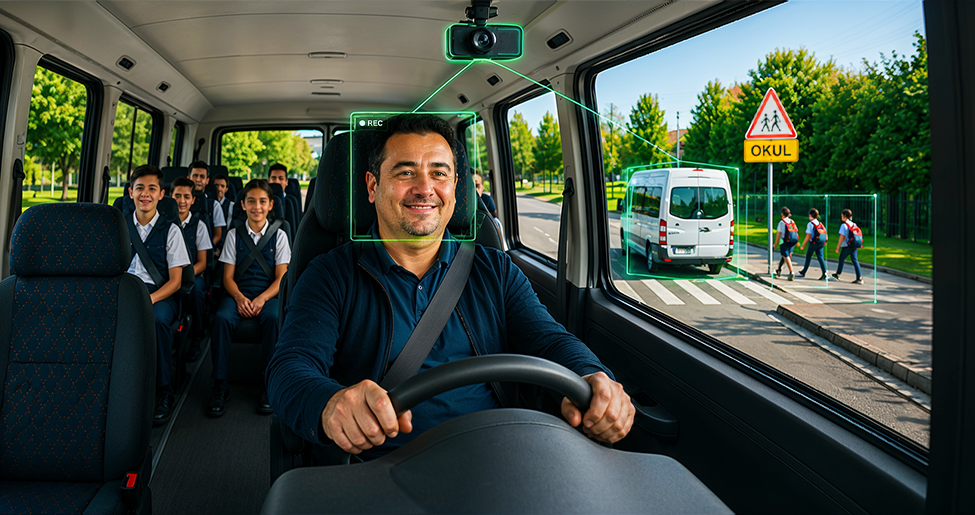
The mandatory camera system in commercial vehicles came into effect on November 29, 2024, with an amendment to the Road Traffic Regulations. According to this regulation, M2 and M3 passenger transport vehicles, public buses, taxis, and school buses must be equipped with a camera system, video recording device, and vehicle tracking system by specific dates.
The purpose of the regulation is to increase passenger and driver safety, to raise inspection standards in transportation services, and to ensure that incidents are recorded. In this article, we will examine the scope of the regulation, the transition schedule, and the mandatory systems in detail.
What is the In-Car Camera Regulation?
The in-car camera regulation is a legal provision within the Highway Traffic Regulation that mandates the presence of certain safety systems in commercial passenger transport vehicles. The legal basis was published in the Official Gazette with number 32737 and came into effect on November 29, 2024.
The main objectives of the regulation are:
- Increasing passenger and driver safety
- Recording of traffic incidents and accidents
- Strengthening audit processes
- Reducing emergency response time
- Preventing risky situations by monitoring driver behavior
Which Commercial Vehicles Are Covered?
The regulation covers the following vehicle types engaged in commercial passenger transport:
- M2 class minivans are passenger vehicles with more than 8 seats (excluding the driver) and a maximum mass not exceeding 5 tons.
- M3 class buses are passenger vehicles with more than 8 seats in addition to the driver, and a maximum mass exceeding 5 tons.
- Public transportation vehicles operated or authorized by the municipality
- Taxis
- Taxis and dolmúșes
- School buses
- Personnel services
Camera Mandate Transition Schedule by Model Year
Different final adaptation dates have been set based on the model year for vehicles within the scope of the regulation to integrate the system:
| Vehicle Model Year | Last Login Date |
| 2018-2022 model year vehicles | First inspection after January 1, 2027* |
| 2017 and earlier model year vehicles | First check-up after January 1, 2028 |
| Newly registered vehicles | In the initial registration phase |
| School buses registered between February 18 and October 1, 2025 | First examination after December 31, 2027 |
For example, if a 2020 model vehicle is inspected in February 2027, the camera system and related equipment must be integrated into the vehicle by that date. The vehicle may encounter non-compliance during the inspection process if the mandatory equipment is missing.
Which Systems Are Mandatory Under the Regulation?
The regulation mandates not a single device, but five integrated security components:
| System | Task | Required Tools |
| Camera System | Recording of in-car and out-of-car footage | All inclusive tools |
| Image Recording System | Keeping records in compliance with regulations | All inclusive tools |
| Vehicle Tracking System | Tracking of vehicle location and movement information | All inclusive tools |
| Emergency Button | Support for rapid response in emergencies | Specific vehicle types |
| Data Security Infrastructure | Record retention and prevention of unauthorized access | All inclusive tools |
Which Vehicles Require an Emergency Button?
Emergency button taxi, shared taxi, shared taxi, minibus, bus, school bus, and personnel bus Because it is mandatory for vehicles with class C specifications used in commercial passenger transport. In addition to the camera system and image recording device in these vehicles, it is a legal requirement to have a button that passengers or the driver can use to request emergency assistance. The technical specifications and placement of the button are defined in the technical specifications of the regulation.
Why Did the Regulation Mandate Camera Recording?
In Turkey, the accurate investigation of traffic accidents and incidents caused by commercial transportation is based on reliable and objective data. The legal grounds for mandatory cameras can be summarized under the following headings:
- Objective evidence recording at the time of an accident: Video recordings that reveal the actual course of events play a decisive role in legal proceedings and insurance evaluations.
- Driver behavior monitoring: Helps in detecting and preventing risky behaviors in unsupervised transportation processes.
- Strengthening passenger safety: In-car recordings enable authorities to respond quickly in unusual situations.
- Raising audit standards: Offers transparency and accountability in public transportation.
From the perspective of fleet managers, these records constitute an important data source that can be used in driver training processes, performance evaluations, and operational improvement efforts.
What do ADAS and DMS do in mandatory camera systems?
Camera systems mandated by the regulation are not merely recording devices. Nowadays, many systems also incorporate ADAS and DMS technologies.
| Technology | What does it analyze? | Focus Area |
| ADAS | Road, traffic, and environmental conditions | External environmental risks |
| DMS | Driver's attention level and behaviors | Driver status |
| ADAS + DMS | Driver and driving environment together | Comprehensive security |
ADAS (Advanced Driver Assistance Systems) is a system that warns the driver in situations like lane departure, following distance risk, or potential collisions by using data from cameras and sensors. DMS (Driver Monitoring System), on the other hand, is a technology that provides warnings by detecting the driver's attention level, signs of fatigue, or phone usage.
These systems are not mandatory core components of the regulation; however, solutions that support these technologies in choosing a regulation-compliant camera system significantly enhance operational security.
For more detailed information about ADAS and DMS technologies, you can check out our “What is ADAS?” content.
Things to Consider When Choosing a Camera System in Accordance with Regulations
Since the regulation specifies technical requirements, the selected camera system must also meet all legal requirements, in addition to recording. The following criteria should be considered in the appropriate system evaluation:
- Technical specification compliance: The camera system to be selected must meet the technical requirements set forth in the Highways Traffic Regulations.
- Authorized installation document: The system installation must be carried out by authorized institutions or organizations, and the issued conformity certificate must be registered in the vehicle registration records.
- Image recorder integration The camera system must work together with the image recording device to ensure uninterrupted recording of footage.
- Proper positioning The camera and recording equipment shall be installed on the vehicle to cover the fields of view specified in the technical specifications.
- Auditable structure Periodic checks must verify that the system is operational, and relevant documentation must be presented during audits.
For more information about systems that meet regulatory requirements and allow you to manage registration and tracking processes through a single platform, Mobiliz in-car camera solutions You can buy it.
What happens to vehicles that do not comply with the regulation?
Businesses that do not integrate mandatory systems into their vehicles in accordance with the determined transition timelines may face the following sanctions:
- Inspection and audit processes: Vehicles without the mandatory system cannot pass periodic inspection and cannot be on the road.
- Administrative penalty Administrative sanctions can be applied in accordance with the relevant legislative provisions under the Highway Traffic Law.
- Operational disruption Vehicles being removed from traffic directly affects fleet operations.
Therefore, it is important for vehicle owners and fleet managers to closely follow the compliance calendar and plan the transition period in advance.
Conclusion
The mandatory camera requirement for commercial vehicles has a transition period extending to 2027 and 2028, depending on the model year. Vehicle owners within the scope of this regulation need to plan ahead for the specified dates to avoid issues during their inspection processes.
When adapting to regulations, choosing the right system is a critical decision for both meeting legal requirements and achieving long-term operational benefits. You can contact us for detailed information about Mobiliz's in-vehicle camera solutions within the scope of the regulation.