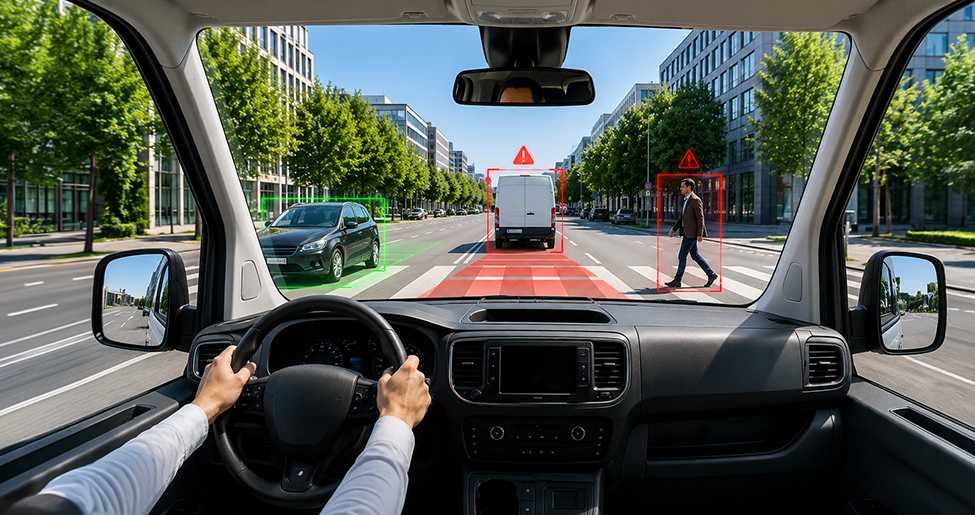
ADAS (Advanced Driver Assistance Systems), analyzes the data it collects from cameras and sensors while the vehicle is in motion, warning the driver in advance of dangers Advanced Driver-Assistance SystemFrontal collision warning, lane departure detection, and safe following distance control are among the most common ADAS features. They are used in commercial vehicle fleets to reduce accident risk and maintain operational continuity.
ADAS is critical for commercial vehicle fleets in terms of safety and operational sustainability. As time spent on the road increases, traffic density, long working hours, and unexpected road conditions become more significant. Therefore, businesses are moving beyond simply recording incidents and are adopting technologies that proactively detect driving hazards. ADAS systems are among the solutions that meet this need.
What are ADAS (Advanced Driver Assistance Systems)?
ADAS, “Advanced Driver Assistance Systems” is the abbreviation for; in Turkish Advanced Driver-Assistance Systems is called. It consists of technologies that warn the driver of potential dangers by analyzing data obtained from cameras and sensors.
The purpose of these systems is to enable the driver to perceive events happening around them more quickly and to draw their attention to the necessary point in critical situations. They are considered important technologies that support driving safety, especially in operations with heavy commercial vehicle traffic.
How Do ADAS Systems Work?
ADAS systems, the vehicle constantly monitors its surroundings while in motion. Data collected by cameras and sensors is evaluated by software; the driver is alerted when predefined scenarios occur.
For example, the system activates and notifies the driver when the vehicle begins to drift out of its lane, when the following distance drops to a critical level, or when there is a risk of a potential collision. Thanks to AI-powered analysis mechanisms, data is processed in real-time, contributing to more informed driving decisions.
What are the Basic Features and Functions of ADAS?
ADAS technologies may offer different features depending on the system used. The most basic features and functions are:
- Lane departure warning – It audibly warns the driver when the vehicle begins to drift out of its lane.
- Forward collision warning – Activates when a critical distance is formed with the vehicle in front.
- Safe following distance control – Alerts when the set minimum distance is not maintained.
- Traffic sign detection Informs the driver by recognizing the speed limit and other road signs.
- Tire inspection – Detects sudden pedestrian movements and allows for reaction time.
These features increase the driver's awareness of their surroundings. They allow for earlier detection of critical situations for commercial vehicles operating in heavy traffic.
What is the difference between ADAS and DMS?
ADAS and DMS Although Driver Monitoring Systems are often considered similar systems, they focus on different areas and complement each other.
| ADAS | DMS | |
| Main focus | Off-road environment | The driver himself |
| What is it watching? | Road, traffic, other vehicles, pedestrians | Fatigue, distraction, phone use |
| Trigger warning | Lane violation, collision risk, distance violation | Eye closure, head nodding, seatbelt violation |
| Together | Complementary | Complementary |
In short: ADAS follows the road, DMS monitors the driver. A more comprehensive security visibility is achieved when the two systems are used together.
Why is ADAS Critical in Commercial Vehicle Fleets?
ADAS is a critical technology for commercial vehicle fleets to reduce accident risk and maintain operational continuity. An accident isn't limited to vehicle damage; delivery schedules can be disrupted, unexpected costs can arise, and operational processes can be interrupted.
In fleets with a large number of vehicles operating in the field, it becomes difficult for managers to closely monitor the entire operation. ADAS technologies alleviate this burden by detecting hazards that arise during driving earlier, and support the establishment of a consistent safety standard across the entire fleet.
How to Integrate ADAS Data into Fleet Management Software
Fleet management is no longer just about seeing vehicle locations. How vehicles are used and events during driving have also become critical data sources for managers.
When information from ADAS systems is transferred to fleet management platforms, driving processes can be evaluated in much greater detail. This data can be used directly for planning driver training, identifying operational improvements, and developing safety policies.
Mobiliz ADAS Solutions: In-Vehicle Camera and DMS Technology
Mobiliz dashcam systems, ensures that events occurring during driving are recorded. DMS technologies, on the other hand, provide important data regarding the driver's attention level.
Thanks to Mobiliz solutions, managers can review incidents that occur during operations retrospectively and monitor driver-related risks more closely. The ability to access video recordings after an accident contributes to the evaluation of the incident and also serves as an important reference in insurance processes.
Return on Investment (ROI) of ADAS for Businesses
ADAS technologies, Many businesses consider it not as a cost item, but as an investment that supports operational efficiency. The ability to analyze events clearly, support driver training with concrete data, and manage processes in a more controlled manner provides long-term benefits.
The cost savings from preventing a single accident, especially in large fleets, can far outweigh the system installation costs. Therefore, ADAS has a strong ROI potential among safety-focused investments.
ADAS Usage and Legal Framework in Commercial Vehicles in Turkey
Interest in driving safety technologies is increasing worldwide. In particular, the rising safety standards in the commercial transportation sector are leading to the wider use of advanced driver-assistance systems.
Businesses operating in Turkey are also investing more in technologies that support driving safety as part of this transformation. This trend indicates that ADAS solutions will have a wider range of applications in the coming years. Especially Mandatory cameras in commercial vehicles With the regulation coming into effect, in-car camera systems and the technologies they contain have become more important for businesses.
ADAS technologies offer significant advantages for businesses looking to increase safety in commercial vehicle fleets and manage operational processes more controllably. A more comprehensive visibility can be achieved when systems that analyze road conditions are combined with technologies that monitor the driver.
As the number of vehicles increases, managing operations becomes more complex. Therefore, early detection of risks that may occur during driving and accurate evaluation of the data obtained are among the important elements of modern fleet management.