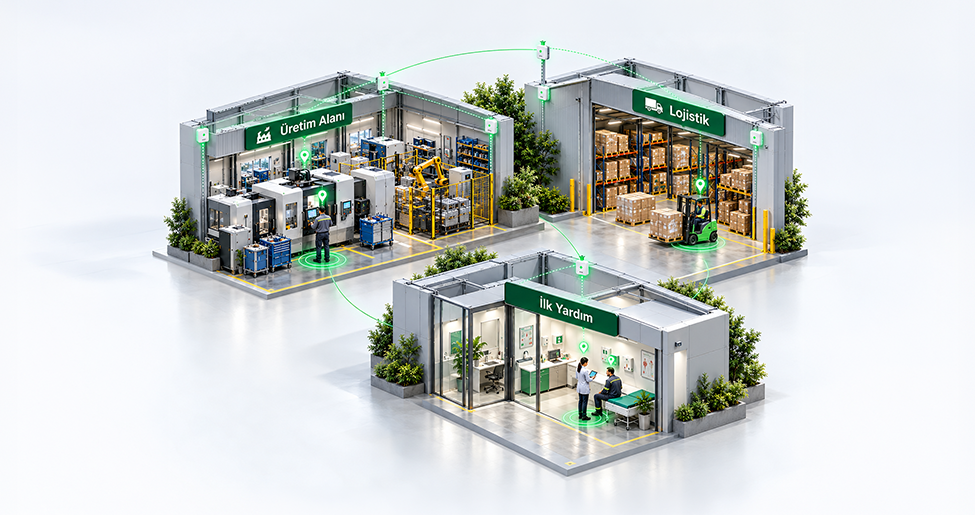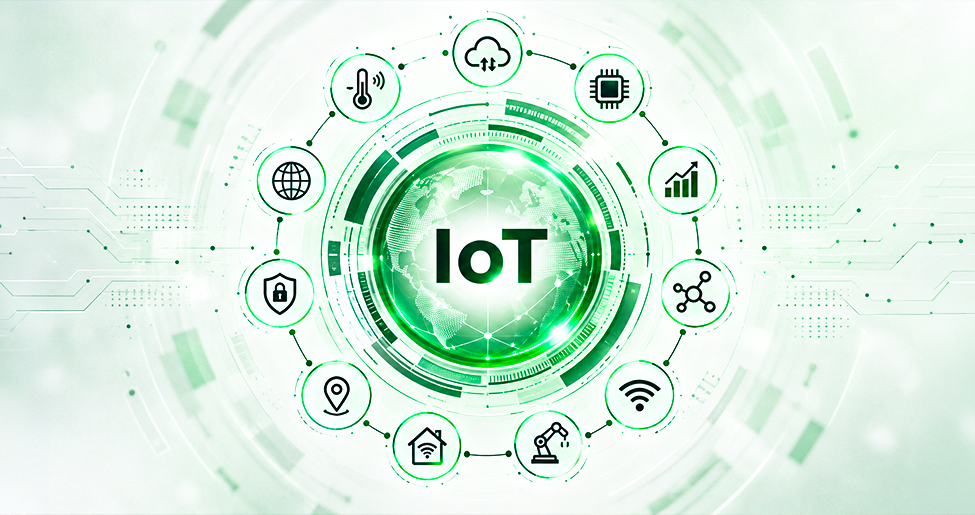
IoT (Internet of Things) is the technology ecosystem that enables physical objects such as vehicles, machines, warehouses, and equipment to connect with each other and central systems through sensors, software, and communication technologies. Through this connection, objects collect data, share that data, and actions can be taken based on the analyzed data.
In an IoT system, sensors collect data such as temperature, location, motion, or energy consumption. The data is transmitted to a platform via connections such as GSM, Wi-Fi, or LoRaWAN, and alarm or notification is generated under specified conditions. Businesses can monitor their vehicles, equipment, and operations in real time through IoT, and make faster decisions with data from the field.
So what is IoT, how does it work, and why is it important for businesses?
What is IoT (Internet of Things)?
IoT refers to technologies that enable physical objects to connect to the internet or a communication network to exchange data. These objects are also called “smart objects” or “connected devices.”.
Different data can be collected through sensors in an IoT system. For example:
- Temperature and humidity
- Location
- Movement
- Energy consumption
- Door opening/closing status
Information such as this can be monitored in real time or at specific intervals.
The primary purpose of IoT is not just collecting data. The interpretation of the collected data and its usability in operational processes are what make the true value of IoT technology. MobiSense IoT Solutions With this approach, it transforms the data from the field into monitoring, alarm, and reporting processes.
What are the Basic Components of an IoT System?
An IoT system is a structure from end to end. In this structure, sensors collect data from the physical environment, the connectivity infrastructure transmits this data, the software platform processes the data, and the interfaces present the results to the user. Therefore, an IoT solution is not limited to a single device. The hardware, connectivity, and software layers must work together and in a coordinated manner.
For example, in a cold chain vehicle, a temperature sensor measures the data. The tracking device in the vehicle transmits this data to the platform via GSM. The platform detects the limit exceedance and the fleet manager sees the alert from the mobile application. The absence or weakness of one of the layers can negatively affect the performance of the entire system. The basic components of an IoT system are:
- Sensors It detects physical data such as temperature, humidity, location, motion, vibration, and door status.
- Actuators: According to the incoming command, it performs a physical action. For example, it cuts the relay, activates the cooler, or unlocks the door.
- Device/gateway: It collects data from the sensors and transmits it to the central system via the communication network.
- IoT platform: It stores data in the cloud or at the edge, processes it, and generates alarms according to predefined rules.
- User interface: Monitoring, reporting and Data analytics It offers the opportunity.
How Does the IoT Work?
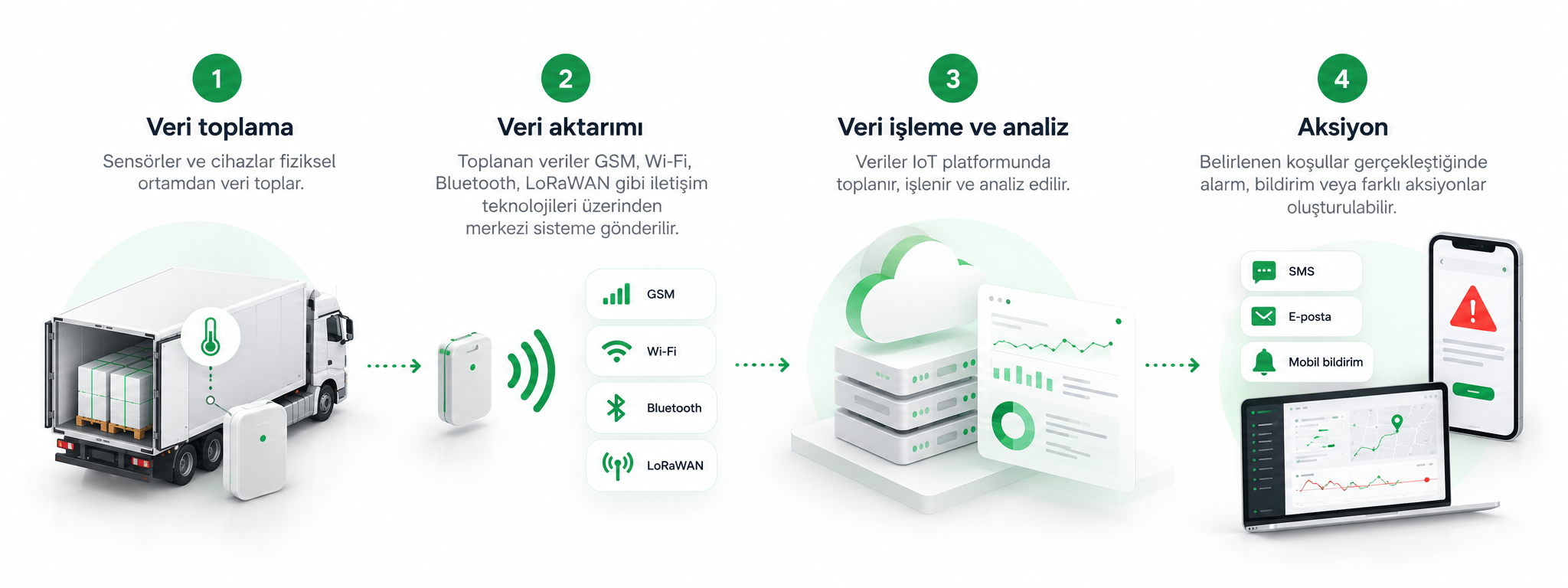
The working process of an IoT system generally consists of four stages:
- Data collection: Sensors and devices collect data from the physical environment.
- Data transfer: The collected data is sent to the central system via communication technologies such as GSM, Wi-Fi, Bluetooth, LoRaWan.
- Data processing and analysis: Data is collected, processed, and analyzed in the IoT platform.
- Action: When the specified conditions are met, an alarm, notification, or different actions can be generated.
For example, a temperature sensor in a cold chain vehicle can detect that the specified temperature range has been exceeded. The system can detect this situation and send an SMS, email, or mobile notification to the relevant parties. The entire temperature history can be reported, and the point at which the shipment was outside the limit and for how long can be documented.
Connection Technologies Used in IoT
The right connectivity technology is selected based on three criteria: whether the device is mobile or fixed, the frequency of data transmission, and the battery life expectancy.
| Technology | Range | Energy consumption | Appropriate use |
| GSM (2G/4G), LTE-M, NB-IoT | As wide as the operator coverage | Medium/low | moving objects such as vehicles, dories, containers |
| Wi-Fi | Indoor | Medium-high | Fixed points such as warehouses and facilities |
| Bluetooth / BLE | Short | Very low | in-vehicle sensors, door sill plates and equipment labels |
| LoRaWaN | Wide (in open areas, kilometers) | Very low | Agriculture, large areas, battery-powered sensors |
What is Industrial IoT (IIoT) and M2M?
Industrial IoT (IIoT) is the use of IoT technologies in industrial environments such as manufacturing, logistics, and energy, and is considered one of the core components of Industry 4.0.
M2M (machine-to-machine communication) is when devices directly exchange data with each other without human intervention. IoT is a broader framework that extends M2M with cloud, analytics, and user interfaces.
IoT in Vehicle and Fleet Management: Telematics
Telematics is the transfer of data collected from vehicles to a central system via communication networks. This data includes location, speed, contact, fuel, driving behavior, and fault information. Telematics is one of the most important application areas of IoT in vehicle and fleet management.
Vehicle tracking systems, When CaN-Bus-supported vehicle tracking devices, temperature and door sensors are combined on the same platform, the fleet manager can monitor route, fuel, maintenance, and load status from a single screen. This data is integrated with the fleet management system. Filo management system It is reported through it and converted into operational decisions.
What are the Benefits of IoT?
IoT technologies can be used for different purposes in different sectors. The main benefits they can provide to businesses are:
- Instant monitoring: The vehicle, equipment, machinery, or environmental conditions can be monitored in real time.
- Operational efficiency Processes that require manual control can be monitored digitally.
- Early warning: Changes in critical temperature, energy or equipment values can be noticed quickly.
- Cost control It can help to closely monitor energy, fuel, maintenance, and operational costs.
- Data-based decision making: Businesses can evaluate their operations based on real-field data.
- Asset management: The location and status of vehicles, equipment and other valuable assets can be tracked.
- Controlling care: With vibration, temperature, and operating hour data, possible malfunction indications can be detected in advance. This can contribute to reducing unplanned downtime.
Where is IoT used?
IoT is used in many sectors where physical assets need to be monitored remotely, primarily logistics, manufacturing, cold chain, energy, plant management, and agriculture. The common point among these sectors is that there is an asset that needs to be present in the field and continuously monitored. This asset can be a vehicle, machine, product, or environmental conditions.
The data tracked varies depending on the industry. In logistics, location and load status, temperature and humidity in the cold chain, vibration in production, and operating time, while in energy, consumption values stand out. The goal is the same in every industry: reducing manual control, detecting problems early, and basing decisions on field data. The main use cases are:
Logistics and transportation
IoT technologies can be used in processes such as vehicle and cargo tracking, temperature monitoring, cold chain management, and equipment tracking. For example, the door sensor on the door can generate an alarm when the vehicle is opened outside the designated delivery point. For details transportation and logistics sector You can take a look at our solutions.
Production
By monitoring data such as the machines’ operating status, energy consumption, temperature, and vibration, it is possible to closely monitor the production processes. For example, a motor whose vibration value exceeds the normal value can be scheduled for maintenance in advance in case of a possible malfunction.
Cold chain
Temperature and humidity values can be monitored during the transportation and storage of temperature-controlled products such as food and pharmaceuticals. An alarm can be generated if the specified limits are exceeded. These processes Cold chain logistics and food sector It is important for.
Energy management
Energy consumption can be monitored from different points and unusual consumption patterns can be detected. Energy sector Companies can also monitor their field teams and distribution vehicles from the same platform.
Smart facilities
Different operational data such as temperature, humidity, energy, equipment, and access can be monitored through a central system.
Equipment and machinery tracking
Motorized or non-motorized assets such as generators, construction machinery, and containers Asset tracking systems These systems track the location of assets, their working hours, and unauthorized use.
Agriculture
IoT technologies can be used in monitoring parameters such as soil moisture, temperature, humidity, and irrigation.
Risks and Challenges of IoT
While IoT provides businesses with instant visibility, it can also bring certain technical and operational risks. As the number of devices operating in the field increases, issues such as security, connection continuity, integration, and data management become more critical.
Risks should be understood not to give up on IoT, but to choose the right solution. A significant portion of these risks can be greatly reduced at the start of the project with the correct device, platform, and process architecture. The main challenges that businesses should be aware of are:
- Data security: Data could be at risk without encryption and authorization at the device, network, and platform layers.
- Working together: Devices from different manufacturers can use different protocols. Therefore, integration must be planned from the beginning.
- Connection interruption: Data loss should not occur in non-coverage areas. For this reason, it is important that the device retains the data in its memory and can transfer it when a connection is established.
- Data load: The contribution of uninterpreted data to the decision-making process remains limited. Therefore, accurate thresholds and reports must be defined.
- Legislation: Location and driver data must be evaluated within the scope of personal data protection (KVKK).
What Should Businesses Pay Attention to When Choosing an IoT Solution?
When choosing an IoT solution, it is not enough to focus solely on the device and sensor specifications. The company's needs and existing infrastructure must also be evaluated. In particular, the following criteria must be considered:
- The problem that wanted to be solved
- The suitability of the sensors and devices to be used
- Connectivity infrastructure
- Data security
- Integration with existing systems
- Reporting and alarm features
- The system being scalable in the future
- Whether the device stores data when the connection is interrupted
- Battery life on battery-powered devices
- Calibration certificate for temperature sensors
- Installation and local technical support available
Transform Your Data into Meaningful Information with IoT
IoT not only enables physical assets to connect to the internet; it also makes the data obtained from these assets available to businesses.
IoT solutions used in many sectors, from logistics to production, from cold chain to energy management, can bring monitoring, analysis, and action processes together under a single structure.
With MobiSense IoT Solutions, you can discover IoT applications tailored to your business needs and manage your field data more effectively. You can request a free demo to see the configuration that suits you.