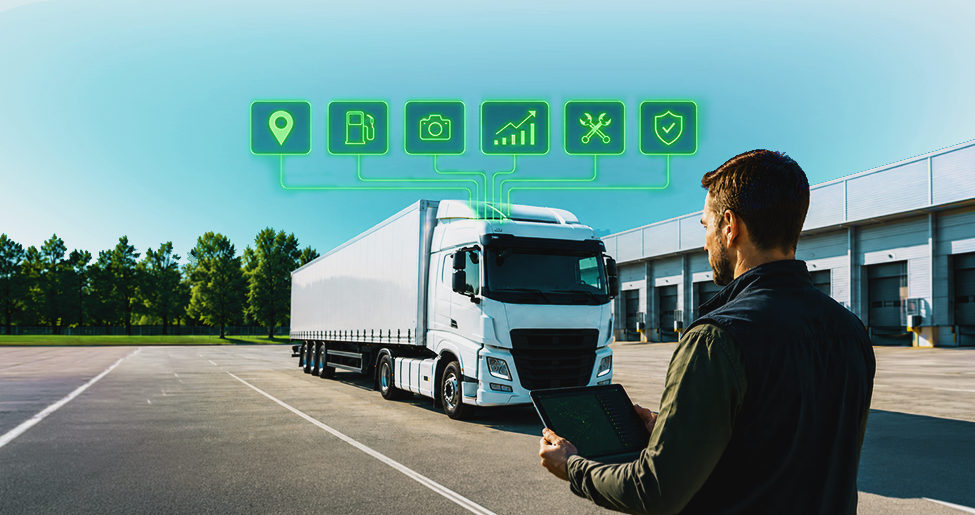
Used in fleet management dashcam systems, are strategic technologies that directly determine operational efficiency beyond simple video recording. Reducing accident rates, increasing driving safety, and controlling operational costs are possible with the right camera infrastructure.
The correct selection process is shaped around three main axes: selecting hardware suitable for the fleet's risk scenario, full integration with the existing vehicle tracking platform, and a measurable return on investment (ROI).
Things to Consider When Choosing a Dashcam
Standard cameras that only record video cannot meet the needs of a professional fleet. To achieve efficiency in the field, the camera must respond to the purpose of use, the type of vehicle, and the risks the fleet faces.
We can list the tangible benefits that criteria such as camera type, image quality, and artificial intelligence support provide to fleet efficiency as follows:
| Evaluation Criterion | Concrete Contribution |
| Camera Type | Provides a monitoring area suitable for the operation model (urban, long-haul, freight/passenger). |
| Image Quality | It allows the clear examination of license plate, road, and environmental details at the time of the incident. |
| Artificial Intelligence Features | It proactively and instantly detects driver errors and road risks. |
| Storage and Infrastructure | It ensures that data is stored on shock-resistant local cards and secure servers. |
| Telematics Integration | It reduces the management burden by combining location, speed, and video data on a single screen. |
Therefore, hardware selection is not just a cost item, but a direct operational decision. A wrong choice can lead to severe consequences, such as the inability to record or access footage that serves as evidence in the event of an accident, alongside an unnecessary budget allocated to unused features. The right camera, on the other hand, responds to the fleet's actual risks and delivers a return on investment in the field as efficiency and safety.
Camera Type Selection According to Your Fleet's Needs
The first step in choosing a dash cam is to determine the angles you want to monitor:
- Single-Channel Systems: It records only the road-facing view. It is suitable for light commercial vehicles and field teams looking for basic-level accident evidence. The Mobiliz MB660 and MB661 models meet this need with 1080p Full HD road recording and remote access capabilities.
- Dual-Channel Systems: It monitors both the road ahead and the interior of the cabin. It is preferred for ensuring driver safety in logistics and distribution fleets. The Mobiliz MB662 model analyzes driver behavior in real-time with its dual cameras facing the road and the driver.
- Multi-Camera Systems: It appeals to heavy-duty vehicle, bus, or hazardous material transport fleets that want to monitor the cabin, road, blind spots, and cargo area simultaneously. The Mobiliz MB671 provides 360-degree vehicle control with support for up to two external cameras, while the MB650 does so with up to four.
| Camera Type | Intended Use | Featured Models |
| Single Channel | Dashcam footage, essential accident evidence | Mobiliz MB660 / MB661 |
| Dual Channel | Simultaneous monitoring of the road and the driver | Mobiliz MB662 |
| Multi-camera | Surround view, cargo area, and blind spot monitoring | Mobiliz MB671 / Mobiliz MB650 |
AI-Powered Alerts and DMS (Driver Monitoring System)
The vast majority of fleet accidents are caused by fatigue, mobile phone use, and distraction. AI-powered video telematics systems intervene before the incident occurs.
DMS (Driver Monitoring System) instantly detects smoking, seatbelt violations, phone usage, and signs of fatigue by monitoring the cabin interior. ADAS (Advanced Driver Assistance System) scans the roadside and alerts the driver with in-cabin audio warnings in case of forward collision, lane departure, and following distance risks.
| Feature | DMS (Driver Behavior Analysis) | ADAS (Advanced Driver Assistance System) |
| Focus Area | Driver's Cabin | Road and Traffic Flow |
| Phone and Cigarette Detection | ✔ | – |
| Seat Belt / Fatigue Detection | ✔ | – |
| Lane and Following Distance Violation | – | ✔ |
| Forward Collision Warning | – | ✔ |
These technologies operate as a proactive safety mechanism that provides driver coaching in the Mobiliz MB662, MB671, and MB650 models.
Night Vision, Resolution and Wide Angle
Achieving a clear image in adverse weather conditions, during night driving, or when passing through tunnels depends directly on hardware quality. Full HD (1080p) resolution, while keeping license plates and road details legible during an incident, whereas these details on lower-resolution cameras often become unusable for accident investigation.
Wide-angle lenses, It offers more coverage than a single camera by including the vehicle's side and rear blind spots into the field of view. Infrared (IR) night vision capability It provides uninterrupted evidence recording regardless of the distinction between day and night, maintaining clarity even in dark environments where headlights are not enough. Together, these three features enable the camera to be not merely a “image-recording” device, but a monitoring system that drives decision-making in the field.
Local Storage and Cloud Synchronization
One of the ways to measure the value of a camera system is the ability to access the recorded footage the exact moment it is needed. A setup relying solely on local recording can risk critical moments in cases such as a card failure or requiring physical access to the vehicle. Therefore, a reliable solution requires a layered approach that combines the strengths of both methods.
The image storage architecture should be based on a two-tier structure:
- Local Storage: Industrial-grade MicroSD cards designed to withstand the vehicle's vibrations and impacts provide uninterrupted local recording.
- Cloud Synchronization: Videos of the violation or accident moment are transferred directly from the device to the center.
Transferring the recordings to a secure, Turkey-based cloud infrastructure enables the center to instantly download and manage videos remotely without having to go to the vehicles.
Integration with Vehicle Tracking Systems / Telematics
The camera system operating independently from the vehicle tracking platform leads to data fragmentation and management difficulties. Mobiliz video telematics solutions combine GPS location, vehicle speed, driver score, and violation videos on a single platform “single screen” approach presents.
In the event of sudden braking, rapid acceleration, or an accident, the map location is matched with the video recording and sent to the dashboard. Operations teams analyze the root cause of the incident without wasting time.
Installation, Assembly, and Fleet-Scale Compliance
On-site installation by professional teams is essential for preserving the vehicle’s original structure and ensuring the safety of the system. Mobiliz’s extensive local technical support network ensures that installation and post-sales service processes run smoothly. Its flexible hardware architecture, designed for scalability, allows for seamless adaptation from small fleets to large-scale operations involving hundreds of vehicles.
Driver Privacy and Compliance with the Personal Data Protection Law
For fleets in Turkey, the use of driver-facing cameras is a sensitive process due to the Personal Data Protection Law (KVKK). The purposes of the road-facing camera and the driver camera must be clearly separated.
The mobile infrastructure is configured to transmit footage only in the event of an accident or violation, rather than continuous cabin monitoring. Supported by authorized access definitions and illumination texts, this structure ensures full PDP Law compliance and institutional policy assurance without violating driver privacy.
How to Calculate the Return on Investment for a Dashcam?
A video telematics investment pays for itself in a short time with the tangible efficiency increase it offers:
- Low Accident Risks: Thanks to artificial intelligence alerts and driver coaching, the accident frequency decreases; vehicle maintenance, repair, and spare parts expenses are reduced.
- Insurance and Legal Claims: Video evidence presented in fraudulent accident claims speeds up insurance processes and prevents compensation burdens.
- High Fuel Economy: Fuel consumption is brought under control by preventing aggressive driving, phone use, and erratic cruising.
Make the Right Choice with Mobiliz Dashcam Camera Solutions
Selecting the right dashcam is shaped by fleet-specific risks, vehicle types, and operating models; there is no single best model that fits every fleet. Mobiliz offers video telematics systems ranging from single-channel to multi-camera systems for every operation, from passenger cars to heavy commercial fleets.
With its Turkey-based secure cloud infrastructure, full integration with a vehicle tracking platform, and DMS/ADAS technologies, it provides not only post-accident evidence but also pre-accident prevention; its extensive local technical support network ensures the entire process, from installation to after-sales service.
You can contact Mobiliz experts to determine the dash cam configuration that best suits your fleet's risk scenario.